

![[Writing Task 1 - Bar Chart] The graph below shows the percentage of different waste disposal in 4 countries.](https://hrsviet.com/uploads/0000/1/2026/01/14/bar-waste-4-country-banner.jpg)
| Band 6.0->6.5 | Band 7.0 ->7.5 |
|
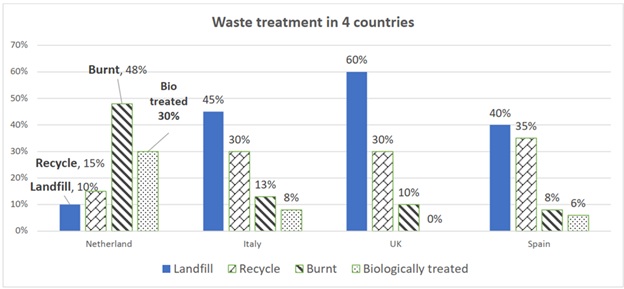
The bar chart demonstrates the percentage of urban waste dealt with via four methods in four different countries. Overall, it can be seen that among four states, the higher amount of urban waste is disposed through traditional methods; meanwhile, environment-friendly ways are utilized to treat small number of garbage. Apparently, landfill is the most common means to dispose garbage in three countries, namely UK with the majority of waste (60%) and Italy, Spain, each copes with 45% and 40% respectively. In contrast, the least of trash is buried in the land in Netherland. It is interesting to note that in Netherland, most of waste (nearly 50%) there is burnt; while, this way is not widely applied in other nations which only burn around 10% of waste. Regarding to the proportion of waste treated biologically, Italy and Spain deal with the same amount, at aproximately 8%; meanwhile, the figure in Netherland is the highest (30%). No data is recorded in the UK. Except for Netherland, the remaining three nations recycle more waste compared with those treated with the biological technique, and the percents of recycled waste in Italy and Spain triple that treated biologically. |
The bar chart illustrates the proportions of urban waste processed using four different methods in four countries. Overall, it is clear that traditional disposal methods, particularly landfill, were the dominant means of waste treatment in most countries, while more environmentally friendly approaches accounted for smaller shares. An exception can be seen in the Netherlands, where incineration and biological treatment were used more extensively. Notably, the UK did not employ biological treatment at all. In terms of landfill, the UK recorded the highest figure, with 60% of waste disposed of in this way. Italy and Spain followed, at 45% and 40% respectively. By contrast, the Netherlands relied least on landfill, with only 10% of its waste buried. Instead, nearly half of Dutch waste (48%) was incinerated, a proportion far higher than in the other three countries, where burning accounted for around 10% or less. Regarding recycling, the UK and Italy showed similar patterns, with 30% of waste recycled in each country, while Spain recorded a slightly higher figure of 35%. The Netherlands recycled 15% of its waste. As for biological treatment, the Netherlands again led, at 30%, whereas Italy and Spain treated only about 8% of their waste using this method. No data was recorded for the UK in this category. |
|
Hạn chế
Lỗi thường gặp
|
✅ Task Achievement
✅ Lexical Resource
✅ Grammar
✅ Coherence & Cohesion
|